nerds:~ #

30Apr/0759

How I Learned to Deal with My Sweet, Elderly & Newly Epileptic Cat

My beloved 17 year old cat named KITTY II has been with me since I was in middle school and I'm now approaching 30. That's actually more than half of my life. As old as she is, she still looks young, a trait that runs in my family ;) . Here's Kitty starring in a poorly Photoshopped (her right eye was too bright) picture:
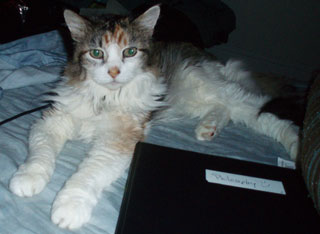
Kitty is still energetic and vocal -- super vocal. I now keep a pair of ear plugs by the bed because she likes waking up at odd hours to yowl like she's dying. If I yell her name, she suddenly goes from Death Meow to innocent kitten meow; it's really unnerving. Kitty lives with me now but she didn't last year when I had a high school friend, Mel, take care of her for a while. Kitty enjoyed the stylings of a large family home in Oceanside, complete with a backyard and koi pond while I worked things out with my apartment.

One day when Mel was taking care of Kitty, I received a call from her saying that she thought Kitty was dying. Apparently, Kitty did this weird thing where she fell on her side, "ran in place, feet in the air" and peed everywhere for about 30 seconds. When she stopped doing that, she woke up dazed, cried out when went eat tuna like nothing happened. My heart sank, I really thought Kitty was gonna go soon and did what I could to visit more even though I lived in San Francisco. I learned at some point that Kitty was having a classic seizures and that elderly cats could live for years with them.

A few months later, I was able to take Kitty back and I immediately took her to the vet to see what could be done. They ran a good $1100 worth of tests and found nothing that could be causing the seizures. That likely meant it was adult-onset epilepsy or a brain tumor. If it was a brain tumor, I wasn't going to try to artificially extend her life so I figured it didn't matter what was causing it, as long as it wasn't something that was preventable.

The first time I saw Kitty have a seizure, it had such a bad impact on me that I called in sick to work; I was a mess. It was about the most awful thing ever. She was sleeping on my pillow and the alarm went off, apparently, loud repetitive noises trigger her seizures, and she started going crazy on the bed. I could see every muscle tense and pee was flying everywhere. I tried to cover my eyes so not see it but I could still feel her shaking the bed. My poor friend, I felt so bad.

Once the seizure was over, I cleaned up and wrote down the date and duration-- something my vet had told me to do. I brought her back to the vet and asked for any sort of advice. "The first one you see is always the hardest and your ability to handle the seizures will get better over time." He was somewhat right and his words really helped me to deal with seeing my little friend suffer. There was only one that was worse than that -- the first time she started running while seizuring, she ran into a wall twice and was jumping uncontrollably in a corner, slamming up against some really hard server rails. I was panicked and couldn't find my glasses. I finally gave up and grabbed her so that she'd stop slamming into things.

I know that you aren't supposed to restrict animals or people having seizures and I made sure not to restrict Kitty as I held her. I just let her do her running and shaking in my hands. My left hand was holing her rib area lightly and my right hand was holding her stomach lightly. Once she was done, I placed her gently on the floor and let her "come to." Even though this was the worst experience thus far, it was the first time I felt like I was able to help Kitty and that made all the difference in the world.

The next time she had a seizure (they occur every 3-8 weeks), I immediately picked her up and let her have a seizure in my hands. It was the first time I didn't have a breakdown.

Once the seizure is done, there's about two additional minutes that she's stunned and her muscles start tensing and curling her paws inward, like a temporary paralysis. Then she wakes up and meows like she's sad or scared and the temporary paralysis wears off.

The last time that Kitty had a seizure, I placed her on my shoulder; one of her favorite spots and I waited for her to wake up. Once she did, she meowed the sad meow but for a much shorter time. Then she was ready to eat. So, if you have recently discovered that your cat has epilepsy, here's a summary of what I learned:

- Cats can live for years with seizures, even elderly cats. Someone I know had a cat that developed seizures at 17 and lived another 4 years.
- The first time you see your cat having a seizure will likely be the worst. From there, it gets better. You'll eventually learn how to handle seeing your good friend have a seizure. Remember they are unconscious when it's happening and they aren't hurting.
- Look out for patterns that may trigger the seizures and refrain from doing that. My cat seems to be triggered by loud, irritating or repetitive noises such as knocking a fork on the side of an aluminium can, a ringing alarm clock or unwrapping crinkly paper (like a Cliff bar).
- Holding your cat gently in the air by supporting its rib cage area and its stomach area lightly will allow your cat to have a seizure without running around and hurting itself. It also helps to make you feel useful. It also doesn't feel freaky, it just feels like the cat is running while you're holding him or her.
- The barbiturates they recommend to suppress seizures may make things worse in the end. They can never stop taking the medicine and you have to give it to them every single day at the same time of day. If you have to go out of town for the weekend and your cat doesn't receive it's daily dose, it is likely to have a seizure. Sometimes, however, there's no other options left.
- Be sure to time how long the seizures last and how often your cat is having them. This will help the vet to treat your cat.

If you have a newly diagnosed epileptic cat and you have any questions or just want to talk, feel free to contact me.

Posted by: Chrissy   Filed under: General Leave a comment
Comments (59) Trackbacks (0)
  1. My 17 year old cat, Squeak, is a diabetic, and on insulin shots twice a day.We constantly monitor him, feed him high protein food, etc. He drinks and pees a lot, a result of his system trying to rid the body of the excess sugar. He’s had a couple of seizures that have been from low blood sugar. In cats, diabetes can instantaneously reverse itself, so you give the insulin, then the pancreas turns back on and bam, no sugar. He’s had several over the last couple of years now, but as he gets older, they have been happening about once a month. He had one this morning, totally triggered by sound. Starting a couple years ago we have seen him flinch to sharp sounds (keyboard tapping, shoes on hardwood floors, etc) and I now believe that the most recent seizures are sound related and not sugar related. His kidneys are slowly failing, part of the disease, and it makes sense to me that the poor functioning kidneys are the underlying cause of his particular seizures. He has the same symptoms as above, twitching followed by full grand mal seizure, then slowly coming around, confused, walking in circles or unsteady, etc. Then he walks around the house, looking at everything, a bit unsettled, and then he’s fine the rest of the day.The seizures are always followed by voracious eating. That is a result of the low blood sugar, We give him Karo syrup, drip it into his mouth with an eye dropper, to help stop the seizures. Please note this is for diabetic cats. The vet says that the seizures won’t kill him and they are much worse to witness then they really are to the cat. Although certainly not pleasant for him either.

    I will not put him on any tranquilizers since they don’t happen often and aren’t that dangerous. The best is to try and keep him safe when he seizes. I gently hold his body so he’s not banging into anything and then hold him and pet him when he comes out of it.

    I told the vet about the sound twitching and she was not familiar with it. Maybe it’s time some of these vets get some updating. Looking at this site shows how many cats have these sound induced seizures, so it’s not an “unknown cause” it’s just that they don’t know.

    Good luck to you all with you furry loved ones!

    • i am so curious if anyone has learned anything more about the sound-triggered tics/twitches. even my neurologist was unfamiliar with it. i induced the cat to twitch once in his presence and he said “that’s weird”.

      i have checked everything i could find on the net for brain tumor symptoms and it was not listed among them. i am reluctant to get Ruth an MRI for numerous reasons aside from the heavy cost. if i see more brain tumor-specific symptoms i may change that, and would give feedback to anyone here.

      an out of left-field notion. with no awareness on the part of vets is it possible that this condition is growing in recent years. i have commented before that the tic reminds me of a less severe version of a tourette’s or prion disease (kuru, CFJ, et al) spasm and he did grow up in an era where he could have been exposed to mad cow beef. i am sure pet food was not policed as closely. the sound sensitive aspect may render this guess useless, but it is just a guess.

  2. Hi
    My elderly cat Marti started having seizures when she was 19. She has had them for 2 1/2 yrs now. They started about every 5 to 6 months then got progressively worse, about every 4 to 6 wks. I found out from the internet that sodium nitrites cause seizures in elderly cats. Sodium nitrite is a preservative found in some cat foods, namely fancy feast, nine lives, and purina. Also in deli meats. Once I took my cat off that cat food..now she is on pro plan, the seizures have stopped. She has not had one in over 2 months. I am positive if I keep her off of that chemical she will stay seizure free. It mainly applies to elderly animals, by the way..she is 22 now, and doing quite well

  3. My 16 1/2 year old cat, Snow, had his first seizure about one month ago. At least, I think it was his first. And he had his second seizure today. I am so worried and sad because I can’t imagine my life without him. I took him to the vet last summer and was told that his blood work was excellent. I was so happy to hear that my little old man was doing great. Now I worry that these seizures may be a sign of his slow end. I was hoping he would be one of those cats that lived to the age of 25. My concern is that I don’t have the money to take him to the vet right now and I am looking for ideas on what i can do to make his quality of life better while I get my finances in order. I appreciate any advice I can get. I love my cat and I am not a very nurturing person. But even my daughter finds it interesting how I just melt when my little guy is around. He has been with me through some of the most difficult times in my life and I want to make sure that I honor him by taking care of him the best way I can.

  4. Thank you Chrissy and all who have shared. Mittens just began having seizures, 4 thus far one per month. Mittens is a 19 year Blue Russian mix and we’ve had her since she was a kitten. I’ve read many of the comments on this blog and will concur…her hearing has become very sensitive to certain sounds. This has been noticiable during the last year or so. She will flinch and twitch at certain sounds such as scraping her food can, tapping, rustling of paper and the like. I know two of the seizures occurred instantly with the rustling of paper. Convulsing on the floor, drooling, urinating, muted sounds and some gutteral sounds, curled spine and pawing. Last year I had her to the vet for a tooth extraction and he ran several tests. Bladder was OK but her kidneys were retaining some toxins. He suggested changing food to lower protein diet. I did and she wouldn’t eat it. So, I returned to the regular can food and continued providing dry cat food for seniors which I started some 10 years ago.
    After the seizures she’s dazed and tired. She will go to eat and drink once she gets her bearings then she roams the house sniffing and exploring as though she experiencing a “new environment” or just getting reaquainted with her old environment. Also twice just prior to the seizures and after hearing the sounds of paper crinkling she bolted around the house from room to room bumping in to walls and furniture. The other two seizures I’m trying to recollect what was occuring when they happened.

  5. i tried to contact you but was unable

  6. my 19 1/2 year old cat also has seizures from the crinkling of potato chip bags. She seizes for about 45 secs to 1 minute then meows and walks in circles no peeing though, I’m really glad i found this because I thought I was imagining things. I never have taken her to a vet glad to hear she may live an even longer life.

  7. Chrissy.
    I am so elated to have found your post. My 12-13 male cat (Ruth) has evidenced seizure-spectrum activity since I got him. He has been through the mill of tests and seen neurologists several times. He had radioactive iodine treatment for hyperthyroid but still had some of the symptoms attributable to that (including distressed meowing and pestering me during the night…similar to Kitty II). Epilepsy seems possible, as does a brain tumor. The problem is that his symptoms that would be tumor are not regionally consistent and MRI has risks due to kidneys, heart, and age.

    The reason I am so elated to read these posts is; He has the same sound-sensitivity issues a couple of you described. I can tell they can begin to trigger seizures and they also cause a Tourette’s looking tick frequently. The same sort of sounds.Tinny, hollow, crinkling. Last night I put the cable remote down on the nightstand and it made a noise that caused him to attack it. My neurologist acted as though he has never heard of this tick (even though he saw it once) or any sound sensitivity related to neuro problems.

    My question for you or Sally is. How do you help increase the kitty’s comfort level with some of the underlying stress or anxiety? Have you been able to learn more about the sound response cause or physiology?

  8. My cat is 18 years old and recently had his first seizure (at least that I know of). My vet put him on Phenobarbital, a tiny dose, twice per day. It is a tiny amount and easy to give him and inexpensive. My vet is a cat specialist and has successfully treated several other elderly cats for seizures with this medication. This seems to be a rather common possibility for elderly cats. My cat also has sound sensitivity like several of the previous posts mentioned.


Leave a comment


No trackbacks yet.